Re-baselining Our Carbon Emissions at GSA
A Crucial Step in ensuring our carbon targets remain credible
As part of our ongoing commitment to climate action and transparency, the Glasgow School of Art is refining how we measure and report our carbon emissions. This includes an important step: re-baselining our emissions, ensuring that our targets and progress are built on the most accurate and complete data available. This updated approach aligns with the Greenhouse Gas (GHG) Protocol and supports our Environmental and Social Justice (ESJ) Framework.
Re-baselining does not mean that our emissions have suddenly increased or decreased; rather, it reflects a more accurate picture of our impact. Our revised baseline for the financial year 2022–23 is 2,062.10 tonnes of CO₂e, with 1,430.84 tonnes from Scope 1 and 2 emissions and 631.26 tonnes from Scope 3. This updated figure incorporates improved data quality, clearer organisational boundaries, and the inclusion of emission sources that were previously missing.
A key part of this work has been reviewing and correcting historical data. For example, earlier estimates overstated gas consumption, which has now been adjusted, removing 70.57 tonnes of CO₂e. At the same time, we have strengthened our Scope 3 reporting by including emissions from staff and student commuting, adding 213.59 tonnes of CO₂e to the baseline. We have also removed over 1,284.93 tonnes of double-counted emissions, ensuring that each source is reported once and in the correct category.
This more robust baseline gives us a clearer understanding of where our emissions come from. Energy use in buildings remains a major contributor, with natural gas accounting for 954.53 tonnes and electricity for 463.95 tonnes. Beyond this, indirect emissions such as commuting, business travel, and leased assets also play a significant role, highlighting the importance of looking beyond our immediate operations when planning reductions.
Encouragingly, the updated methodology also allows us to track progress more reliably. Emissions have reduced from 2,062.10 tonnes in 2022–23 to 1,926.52 tonnes in 2024–25, and are projected to fall further to 1,370.68 tonnes by 2027–28. These projections reflect the impact of ongoing energy efficiency measures and planned carbon reduction initiatives.
The diagram below illustrates how our emissions are defined across Scope 1, 2, and 3, and how these fit within our reporting and net zero boundaries.
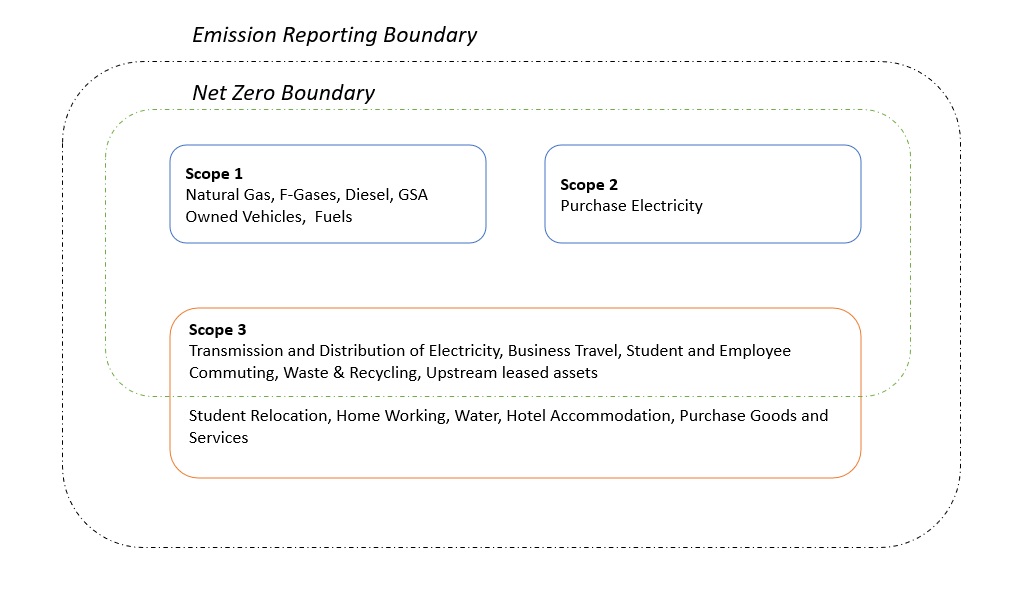
Re-baselining is a crucial step in ensuring that our carbon targets remain credible, transparent, and achievable. It strengthens our ability to prioritise the right actions and measure real progress as we work towards our Net Zero target of 2037. Going forward, alongside our statutory reporting under the Public Bodies Climate Change Duties (PBCCD), we will also publish our emissions in line with the GHG Protocol, providing greater consistency, clarity, and comparability in how we report our carbon footprint.
As we move into the next phase of our carbon management plan, we will continue to refine our data, expand our coverage of Scope 3 emissions, and use these insights to drive meaningful reductions across the organisation.